





























Unsettled by the markets? It’s totally understandable. However, it’s crucial to remember that paper losses are just that until you sell. And history tells us that staying invested is your best course of action right now.
Market turmoil unsettling for investors
If you have investments, you’re probably feeling at least a little bit anxious about the market reaction to the chaos of the Trump presidency to date. Earlier this month, the announcement of ‘Liberation Day’ tariffs on 2nd April triggered new market lows. The S&P500 hit a trough for the year to date on 4th April.
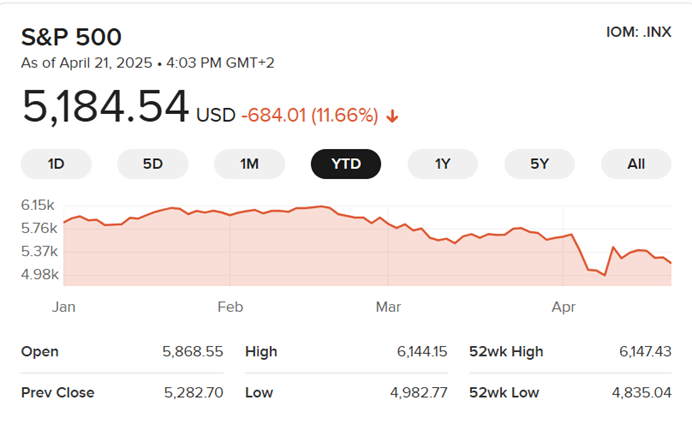
Source: Refinitiv
It’s completely natural to feel unsettled when markets are this volatile and the headlines are incessantly reminding you of your losses. However, it’s also important to remember that a market dip is not a loss unless you lock it in by selling.
Paper losses versus realised losses
On paper, the majority of investors have made losses this year with the value of their investments declining. However, while losses are unrealised, the value could go back up in the future. In fact, history tells us that this is almost certain to happen at some point.
A loss only becomes real and permanent when you sell an investment for less than you paid for it. That’s the point at which you lock in the loss.
Paper losses can recover whereas realised losses cannot. Which is why smart investors are hanging on in there and riding out this particularly turbulent storm.
Historically, over the long term, markets have always proved to be resilient and there’s no reason to believe that they won’t do the same this time round.
Reason for optimism: stock market crises of the last 40 years
The three biggest stock market crises of the last four decades give us reason for optimism. Let’s take a look:
Black Monday (19th October 1987)
On Black Monday, the Dow Jones Industrial Average fell by 22.6% in a single day, the largest one-day percentage drop in its history. However, stock markets rebounded swiftly. Within just two trading days, the Dow Jones Industrial Average regained 288 points, recovering approximately 57% of its losses from the crash. Less than two years later, US markets had fully recovered and surpassed their pre-crash highs.
Global financial crisis of 2009
In 2009 global markets were in the depths of the worst financial crisis since the Great Depression. The crisis, triggered by the collapse of major financial institutions and a bursting housing bubble, sent shockwaves through economies worldwide.
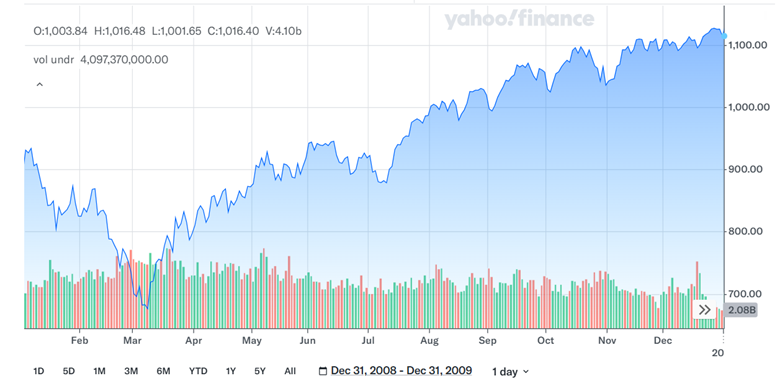
On 9th March 2009, the S&P 500 plunged to a low of just 676 points—a level not seen since the mid-1990s. Investor confidence was at rock bottom, and fear dominated the headlines, much like now. Yet from that point, markets began a powerful recovery as illustrated on the graph.
By early 2013, the S&P 500 had not only regained all its losses but reached new all-time highs, demonstrating the resilience of long-term investing through even the most severe downturns.
Covid crash of 2020
In early 2020, global markets were rocked by the sudden onset of the COVID-19 pandemic. As countries went into lockdown and economic activity ground to a halt, panic selling swept across financial markets.
Between mid-February and late March 2020, the S&P 500 fell nearly 34%, marking the fastest bear market in history. Other major indices, like the FTSE 100 and the Hang Seng Index (HIS), experienced similar sharp declines.
However, thanks to unprecedented fiscal and monetary support from governments and central banks, markets staged an equally remarkable rebound. By August 2020, the S&P 500 had fully recovered its losses, and many global indices followed suit.
Stay invested
The fact is that at each of these crisis points for markets of the last 40 years, the best course of action would have been to stay invested. It’s no different now. The key is to remain strategic and not let short-term market volatility dictate your decisions.
For those approaching retirement who may have a shorter investment timeframe, it’s worth talking to a financial adviser to devise a strategy focused on preserving capital and minimising unnecessary withdrawals, to help you sustain your retirement funds over time.
If you’d like to talk through any concerns about your investments with a professional, we are here to help. Don’t hesitate to get in touch.

A leading provider of expat financial services and wealth management services across Asia.


