





























While it’s true that the stock market involves risk, don’t dismiss it as too risky. We explore the relationship between risk and reward and outline the strategies investors can employ to minimise risk and maximise return when investing in the stock market as part of a holistic financial plan.
Risk: The main reason people avoid the stock markets
Fear of risk is the most common reason people give for avoiding investments in stocks and shares.
This is because most of us like certain outcomes, especially when it comes to our hard-earned cash. That’s why people choose to deposit their cash in savings accounts. The bank tells you how much interest you will earn and, if you save in a jurisdiction with a stable banking system that features a deposit insurance scheme, your cash balance is guaranteed up to a certain level. Theoretically, at least.
This is not a 100% risk-free strategy (such a thing doesn’t exist). While your balance is probably not going to fall in real terms, its value will be eroded if the interest rate on your savings is below the rate of inflation. And with inflation running high in many countries, that’s the case for millions of people around the world.
And that’s not the only price you pay for perceived safety: you will also be getting a lower return on your investment than you can get elsewhere.
If you’re investing over a short time horizon (less than five years), cash deposits may be the best option for your savings, but if you are investing for the long term, there are better choices out there. And the stock market is one of them.
How risky is investing in the stock market?
Stock markets do not offer certain outcomes that we can all agree on.
Volatility is a given, which is why the risks are clearly signposted whenever you make a legitimate stock market investment.
Nevertheless, investing in stocks remains one of the best and most reliable ways to grow your wealth, if you can stay invested over the long term.
To give an example, the S&P 500 Index has returned an average of around 10% a year (not accounting for inflation) over the last century. Some years, the return has exceeded that, others it has been negative.
This chart shows the annual percentage change of the S&P 500 index over the last 30 years. It illustrates the importance of a long-term investment horizon.
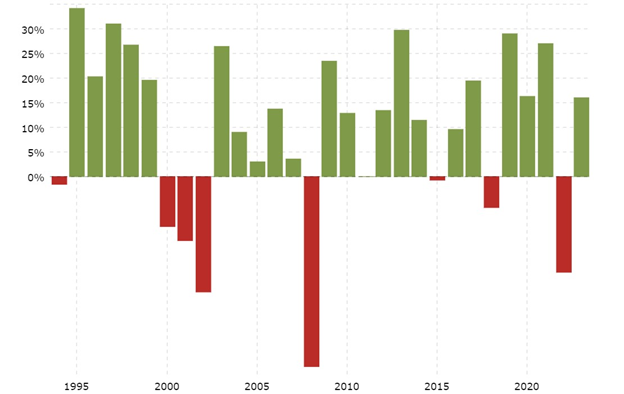
If you had invested in 1999, and sold in the short term, you would have made a loss thanks to the dot.com crash of the early 2000s, which triggered three consecutive years of negative returns.
However, if you had kept those stocks until now, you’d be looking at a healthy overall return. The losses that occurred in the years when the return was negative would have been mitigated by the gains made every other year
This example demonstrates why buy and hold is the recommended strategy for the majority of retail investors.
Five other tips to mitigate stock market risk
A long-term investment horizon gives you the best chance of investment success, but there are other strategies you can implement to balance risk and return.
Here are five things you should do to maximise return and minimise risk.
- Ensure you assess your tolerance to risk carefully and invest accordingly
- Choose investments that match your risk profile
- Don’t try to time the markets
- Diversify your investments across different assets, countries, and industries
- Review your investments regularly to check that they are on track
Professional financial advice for stock market success
Working out how to do all this on your own can be difficult. But you don’t have to.
Infinity’s professional financial advisers can help you implement a holistic financial plan that encompasses all these action points. Working with an expert will ensure that risk management is integrated into your long-term investment strategy.
Contact us for a risk profile assessment and financial planning consultation.

A leading provider of expat financial services and wealth management services across Asia.


