




























How expensive is it to live in Asia? Cost of living comparisons are useful if you are considering a move as underestimating costs can have a significant impact on your financial planning.
How expensive is it to live in Asia?
Certain cities in Asia might have a reputation for being expensive to live in but just one Asian city figures in the top 25, according to figures from the website Numbeo, ‘the world’s largest database of user-contributed data about cities and countries worldwide’.
When it comes to the cost of living by city, Numbeo’s figures for 2024 show that Singapore is the highest-ranking city in Asia in 24th place. The most expensive city in the world is Hamilton in Bermuda with Switzerland taking the remaining top five spots with Basel, Zurich, Lausanne, and Bern.
Numbeo’s cost of living index gives prices relative to New York City (NYC), which is the baseline index, equivalent to 100%. The index indicates the relative prices of consumer goods like groceries, restaurants, transportation, and utilities but, importantly, excludes accommodation.
So therefore Singapore, with a cost of living index of 81.9%, is 18.1% less expensive than New York City (excluding rent).
A comparison of the cost of living in different Asian cities
Living in Southeast Asia comes out surprisingly competitive when it comes to the cost of living. Only Singapore, Hong Kong, and Seoul feature in the top 100 most expensive cities
| Overall world ranking | City | Cost of living index |
| 1 | Hamilton, Bermuda | 137.4 |
| 24 | Singapore | 81.9 |
| 64 | Hong Kong | 71.5 |
| 72 | Seoul | 70.3 |
| 235 | Bangkok | 42.4 |
| 241 | Phnom Penh | 42.0 |
| 253 | Phuket | 39.8 |
| 267 | Beijing | 37.1 |
| 288 | Kuala Lumpur | 34.6 |
| 300 | Chiang Mai | 33.0 |
| 310 | Ho Chi Minh City | 32.1 |
| 311 | Penang | 32.1 |
| 317 | Hanoi | 31.7 |
| 370 | Karachi, Pakistan | 19.3 |
Many Southeast Asian cities compare very favourably globally in terms of cost of living, and this, along with generous salary packages and an exceptional quality of life, attracts many expatriates from around the world to the region. But how do they compare with each other?
Comparing the cost of living in Asia
Singapore comes out number one in the cost of living index in Asia followed by Tel Aviv, Hong Kong, and Seoul.
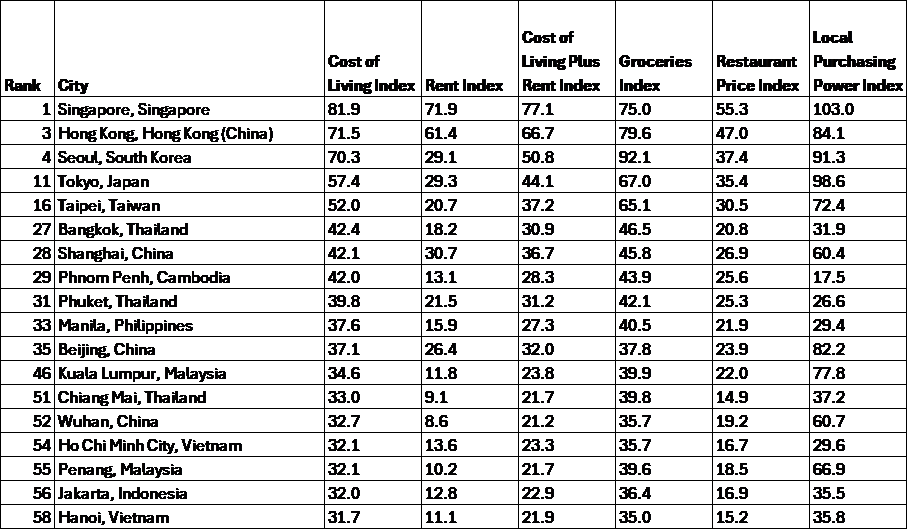
The table below includes a selection of cities in Asia – the ones where Infinity’s clients are largely based. It compares several different indices. Note that for the overall rankings (left-hand column), Numbeo includes countries in the Middle East, Cyprus, and Armenia in the Asia rankings.
The rent index
The rent index estimates the price of renting an apartment in each city, again, comparing it to New York City. Therefore, in Hong Kong, which has a rent index of 61.4%, average rental prices in the city are 38.6% lower than those in NYC.
For most of us, accommodation is our biggest monthly cost so this is an important index to consider. Remember, it isn’t included in the overall cost of living index, the left-hand column in the table.
Singapore (71.9), Hong Kong (61.4), Shanghai (30.7), and Tokyo (29.3) are top of the rental league table in this sample of Asian cities. What is notable is that average rents in many Asian capitals are low by global standards – examples include Taipei with a rent index of 20.7, Bangkok (18.2), Phnom Penh (13.1), and Kuala Lumpur (11.8). Bear in mind that these are average rents and there will be a huge variation between the least expensive and the most expensive properties.
It’s also worth noting the difference in ranking between cost of living and rent. While Shanghai is 28th when it comes to the overall cost of living in Asia, it comes ninth in this sample of cities for rent. Beijing’s position is 35 and 13 respectively. While day-to-day living costs in these cities are low, a disproportionate percentage of your costs will be on accommodation.
Cost of living and rent index
This is perhaps the most useful of the indices, estimating the prices of consumer goods, including rent, in comparison to NYC. This will give you the most comprehensive picture of overall costs.
It’s no surprise that Singapore (77.1) and Hong Kong (66.7) come out top here. Expats living in KL (23.8) and Vietnam (Ho Chi Minh City 23.3/Hanoi 21.9) benefit from extremely competitive living costs and rent. Those with decent salary packages can enjoy a high standard of living with plenty of disposable income left over. This gives them a unique opportunity to get ahead with retirement planning.
The groceries index
This index provides an estimation of grocery prices in each of the cities, relative to NYC. A typical basket of good will cost most in Seoul (92.1) and Hong Kong (79.6). Again KL (39.9) and Vietnam (Ho Chi Minh City 35.7/Hanoi 35.0) offer great value for money.
Restaurant prices index
Eating out is an integral part of the Asian experience! This index compares the prices of meals and drinks in restaurants and bars to those in NYC.
In general, your money goes much further in Asia than in Europe and the States. Prices in Thailand and Vietnam in particular offer the opportunity to dine out for very little.
Local purchasing power index
This index indicates the relative purchasing power in each city based on the average net salary. A domestic purchasing power of 50 means that residents with an average salary can afford, on average, 50% fewer goods and services compared to residents of New York City with an average salary.
Locals in Singapore (103) and Hong Kong (84.1) benefit from high local purchasing power. KL does well here too (77.8). In fact, high local purchasing power and low cost of living make KL an extremely attractive place for expats to live. But maybe I’m biased!
Relocating to Asia? Get sound financial planning advice
Of course, understanding costs is important when you relocate but it’s just one financial planning job of many. If you’re preparing for a move, you’ll need to review all aspects of your financial plan from life and health insurance to estate planning and investment management.
Using a financial adviser familiar with expatriate financial planning concerns will ensure that nothing slips through the cracks. Why not contact me for a review of your situation?
Financial Consultant
I work as a Financial Planner with expat clients to meet their financial planning needs and goals, with a focus on adequately protecting expats & their families, and helping people to grow their savings over the long term. I strongly believe in building meaningful and lasting relationships with clients to ensure the best client outcomes are achieved.


