





























If you are invested in the stock market, it’s safe to say that since the beginning of the year the value of your portfolio will have taken a tumble, which may well have left you demoralised.
The incessant media chatter has talked the economic fallout of the coronavirus up to biblical proportions. With the World Trade Organisation predicting a drop in global trade worse that during the financial crisis of 2008 and the IMF forecasting the worst recession since the Great Depression it is totally understandable that investors are in a high state of anxiety.
So it is no surprise that people are selling up and banking the cash. But is this so-called caution the best strategy right now?
The simple answer is no.
One thing it is important to remember is that if you’re building wealth to secure your financial future you are an investor, not a speculator. So while your heart may be looking at stock values dropping and screaming ‘sell, sell, sell’ you should tune out the media noise and save yourself a whole lot of stress by hunkering down, staying focussed on the long game and weathering the downturn. You simply don’t need to get emotionally involved in the short term ups and downs of the market.
Warren Buffett perhaps put it best when he said ‘… what you need is the temperament to control the urges that get other people into trouble in investing.’ In other words, don’t follow the herd by selling just because everyone else is and prices are therefore falling.
Now is the time to assess what types of equities you are holding. Make sure you are investing into good, quality companies, with strong balance sheets and adequate cash flows and avoid companies which are highly leveraged, or heavily affected by the current market conditions.
If you are invested into quality, then you don’t need to make whole sale changes at this time.
In fact, now is exactly the time that you will find some of the best opportunities for investing. This is because when there are whole market sell offs, some companies share prices will have dropped, not because of their own profit warnings, but just because money flowed out of the market as a whole. This was due to margin calls having to be settled, and urgent cash was needed from the market.
It may seem counterintuitive to buy when everyone else is offloading stock but if you have cash to invest you should ignore what the markets are doing, invest in quality companies, or well diversified multi asset portfolios, as early as you can and keep saving regularly month by month to consistently build a diversified portfolio.
Waiting for more stable times to buy stocks may seem the more sensible option but it isn’t because you are likely to miss the boat and buy in too late. If you need convincing consider this:
Stock market fluctuations have historically followed a pattern and it’s a very simple one: what goes down must come up! Since investing began, big stock market falls are followed by rebounds. While the time it takes for the markets to bounce back might vary, making it hard to predict the right time to buy back in, the fact that they do is immutable.
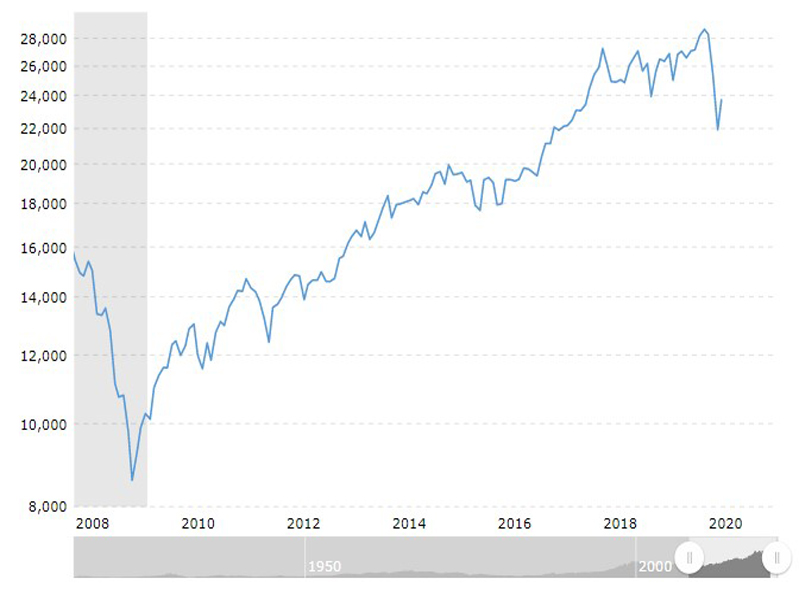
S&P 500 Source: https://www.macrotrends.net/1319/dow-jones-100-year-historical-chart
Just for a moment, imagine you had fallen into a decade-long coma in March 2009, at the trough of the graph above. You would have checked out of a world with headlines as doom-mongering as those we are seeing now: major banks were going belly up, stalwarts of the business world, such as General Motors, were begging the government for bailouts, unemployment was soaring and the Dow Jones was falling at its fastest rate since the Great Depression. Yet if you’d woken up ten years later in 2019 you would have found stocks at an all time high (the peak of the graph) and markets in the midst of the longest bull market run in history.
And stock values followed the same general pattern in the aftermath of numerous seemingly-cataclysmic historical events including the 1983 nuclear stand-off between the US and the Soviet Union, when it seemed the end of the world was nigh, revolution in the Eastern bloc in the 1980s, the Gulf War between 1990 to 1991, the dot-com bubble of the early 2000s, and the Arab Spring conflicts between 2010 to 2012.
History has proved that long term investing in a balanced portfolio pretty much always pays off regardless of the short term volatility which occurs within the investment timeframe in response to political and economic crises.
That’s why I truly believe that staying invested through this volatile episode, and carrying on a dollar cost averaging strategy if you can, means that you will benefit from the rebound when it does come and be rewarded in the long term for keeping your nerve.
Keep calm and carry on investing for the long term! For more information, please contact me at cturner@infinitysolutions.com.

A leading provider of expat financial services and wealth management services across Asia.


